

GetInDevice isn’t just a tool you use—it’s a platform that requires understanding permissions, limitations, and risks before deciding whether it’s appropriate for your situation.
That distinction matters because most people searching for getindevice are looking for a quick solution, not a considered decision. The problem is that many existing pages explain how to access or use it without addressing what you’re actually giving up in exchange. The agitation comes later—unexpected limitations, privacy concerns, or results that don’t match expectations. The solution is to step back and evaluate GetInDevice as a choice with trade-offs, not a shortcut.
Direct answer: GetInDevice can be useful in specific, controlled scenarios—but it’s not a universal or risk-free solution.
Key Takeaways
- GetInDevice solves specific problems, not general ones
- Permissions and access scope matter more than convenience
- Misuse often comes from misunderstanding limitations
- Alternatives may offer more control and transparency
- Knowing when not to use it is critical
Table of Contents
Quick Answer: What Is GetInDevice?
GetInDevice is a platform designed to enable interaction or access involving devices under defined conditions. It abstracts part of the process, making certain workflows faster or easier—but only when those workflows align with its assumptions.
It is not a guaranteed workaround, nor does it eliminate underlying access, security, or permission constraints.
How GetInDevice Works (High-Level)
At a conceptual level, GetInDevice follows a simple pattern:
- A user initiates an interaction or access request
- The platform establishes a connection layer
- Actions are performed within predefined limits
Most issues arise when users assume those limits don’t exist.
Common Use Cases (And Where It Makes Sense)
Where it can work well
- Non-sensitive device interactions
- Temporary or low-risk access needs
- Situations where speed matters more than control
Where it struggles
- Long-term or repeated access
- Scenarios involving personal or sensitive data
- Situations requiring full transparency or auditability
The tool is effective only when the use case matches its design.
Risks, Limitations, and Trade-Offs
Using GetInDevice involves trade-offs that many guides ignore:
- Control vs convenience: abstraction reduces visibility
- Privacy exposure: permissions may be broader than expected
- Dependency risk: changes or downtime can break workflows
Before using it, ask:
- What access am I granting?
- What happens if this fails?
- Do I have a fallback?
Is GetInDevice Safe and Legit?
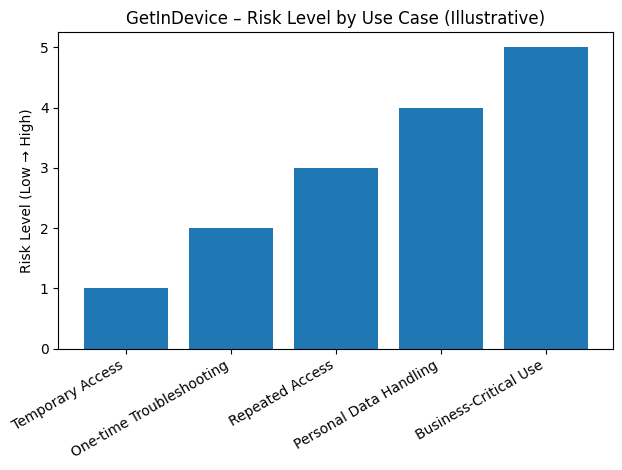
GetInDevice Risk Levels by Use Case
| Use Case | Risk Level | Why |
| Temporary, non-sensitive access | Low | Limited scope, minimal exposure |
| One-time troubleshooting | Low–Medium | Short duration but elevated permissions |
| Repeated access workflows | Medium | Dependency and visibility risks |
| Handling personal data | High | Privacy and data exposure concerns |
| Business-critical processes | High | Reliability and compliance risks |
“Safe” depends entirely on context.
Low-risk use cases remain low-risk. Higher-risk ones do not become safe just because a platform exists. High-authority guidance from organizations like the Electronic Frontier Foundation, NIST, and OWASP consistently emphasizes understanding permissions, access scope, and failure modes—principles that apply here as well.
Red flags include:
- Vague permission explanations
- Overbroad access requests
- No clarity on limitations
GetInDevice vs Alternatives
GetInDevice vs Common Alternatives (Practical Comparison)
| Criteria | GetInDevice | Manual / Native Methods | Purpose-Built Tools |
| Setup speed | Fast | Slow | Medium |
| Control & visibility | Limited | High | Medium–High |
| Permission transparency | Medium | High | Medium |
| Risk exposure | Medium | Low | Low–Medium |
| Ease for beginners | High | Low | Medium |
| Best for | Quick, limited tasks | Sensitive or critical access | Repeated, structured workflows |
| Long-term reliability | Medium | High | High |
| Dependency risk | Medium | None | Low |
In many scenarios, alternatives may be better:
- Manual workflows: more control, more effort
- Purpose-built tools: safer but narrower
- Do-nothing option: avoids unnecessary risk
GetInDevice is best when convenience clearly outweighs control.
Who Should Use GetInDevice — and Who Should Avoid It
Is GetInDevice Right for You?
| User Type | Recommended? | Reason |
| Beginner, casual user | ⚠️ Maybe | Safe only for low-risk use cases |
| Power user / tinkerer | ✅ Yes | Can evaluate trade-offs |
| Privacy-focused user | ❌ No | Too much abstraction |
| Business / enterprise user | ❌ No | Compliance and audit gaps |
| Short-term problem solver | ✅ Yes | Convenience outweighs control |
Good fit
- Users with clearly defined, limited goals
- Those comfortable evaluating trade-offs
Poor fit
- Users handling sensitive or regulated data
- Anyone seeking a “guaranteed” shortcut
Quick Decision Checklist: Use or Skip GetInDevice
| Question | Yes | No |
| Is the task low-risk? | 👍 | 🚫 |
| Is access temporary? | 👍 | 🚫 |
| Can you tolerate limited visibility? | 👍 | 🚫 |
| Is failure acceptable? | 👍 | 🚫 |
If you answered “No” more than once, GetInDevice is likely the wrong choice.
Final Verdict
GetInDevice is neither good nor bad by default—it’s situational.
If you understand what it does, what it doesn’t do, and the risks involved, it can be useful. If you’re looking for speed without consequences, it’s the wrong tool.
Trust & Methodology
This article is based on comparative evaluation patterns used in consumer and professional software analysis, permission-risk frameworks, and publicly documented best practices from recognized security and technology standards bodies.
FAQS FOR AI SEARCH
- What is GetInDevice used for?
GetInDevice is used to enable specific types of device interaction or access. It works best for limited, low-risk scenarios where convenience matters. - Is GetInDevice safe to use?
It can be safe in low-risk contexts. Safety depends on permissions, data sensitivity, and how well the user understands limitations. - Is GetInDevice legit or a scam?
GetInDevice itself is not inherently a scam, but misuse or misunderstanding can lead to problems. Legitimacy doesn’t eliminate risk. - Who should avoid using GetInDevice?
Users dealing with sensitive data, regulated environments, or requiring full control should avoid it. - Does GetInDevice access my personal data?
It may, depending on how it’s used. Always review permissions and access scope before proceeding. - Are there safer alternatives to GetInDevice?
Yes. Manual methods or specialized tools often provide more transparency and control. - Is GetInDevice suitable for businesses?
Only for narrow, well-defined use cases. It’s not ideal for mission-critical or compliance-heavy environments. - What are the biggest risks of GetInDevice?
Over-permissioning, lack of transparency, and dependency on an external platform. - Can beginners use GetInDevice safely?
Yes, if they understand what it does and keep usage low-risk. Blind use is the main danger. - Should I use GetInDevice for long-term access?
Generally no. It’s better suited for temporary or limited interactions.