

Software development doesn’t usually flow smoothly. One person has a feature idea; someone writes some code; tests start; something breaks, and then the whole mad rush of trying to find out who broke it, who will fix it, and whether it was fixed at all… gets very messy if it’s all happening over disjointed emails, spreadsheets, IM systems, and individual bug-tracking applications.
You’ll see the term Endbugflow when developers begin seeking more organized methods for managing workflows, especially for software bugs, automation, bug tracking, and quality assurance.
The idea is fairly simple: instead of treating a bug as an isolated ticket, the bug’s entire lifecycle is managed from discovery through resolution and verification.
Online sources mention Endbugflow as a bug-flow/process concept/platform related to workflows, organization, Analytics, and software quality. Although Endbugflow product information online is sparse and variable, it is necessary to use the provided information as fact on bug-flow, but to treat any related product information with caution.
Table of Contents
What Is Endbugflow Software?

Endbugflow software can be understood as a software quality and workflow-management approach designed to organize the complete lifecycle of bugs and development issues.
The practical definition of bug flow begins when someone finds a defect. There is a bug-creation stage that includes identifying the problem, documenting the problem description and evidence, prioritizing the fix (severity and cost), assigning it to the right assignee, resolving, and testing the bug. It finally ends with closure.
In principle, this looks uncomplicated until it’s time for a development team of a certain size to build a complex application system.
A bug could potentially require several people, including developers, testers, PMs, Support Specialists, and a release manager, to fix. The process breaks easily when these stakeholders communicate with each other through separate tools, which loses important details about the defect. A proper unified Bug-Flow process reduces this loss.
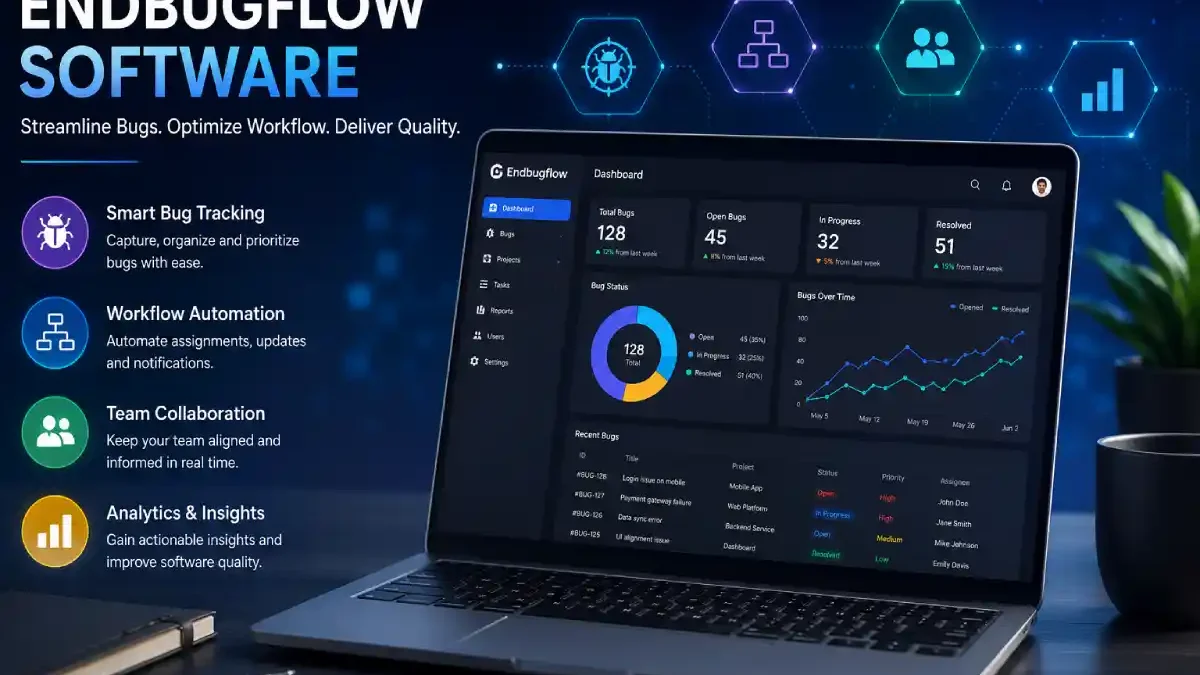
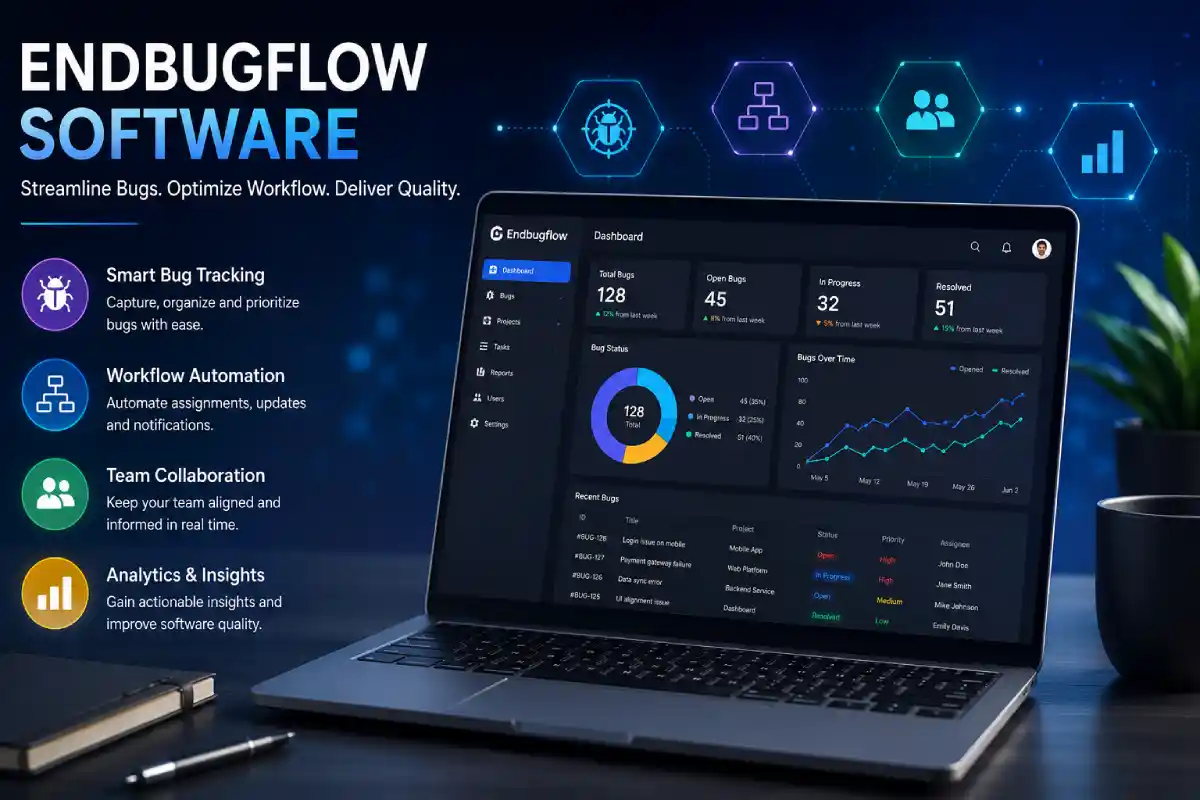
The official Endbugflow Software website presents Bug-Flow Management as an integrated lifecycle that manages bugs through identification, tracking, prioritization, assignment, resolution, validation, and closing, providing at the same time process visibility, collaboration, reporting & analysis, scalability, and integration with agile practices.
A Simple Definition
Think of Endbugflow as the traffic-control layer for software problems.
A bug should not simply be reported and forgotten. It needs a clear route:
Detect → Record → Prioritize → Assign → Investigate → Fix → Test → Verify → Close
A well-designed workflow makes every stage visible.
Why Bug Flow Management Matters
Bug tracking and bug management are not the same thing.
A bug tracker primarily records defects. Bug-flow management goes a step further by organizing what happens after the defect enters the system.
Imagine a tester discovers that a payment button stops working under a particular condition.
A basic ticket might say:
“Payment button not working.”
The information is nowhere near good enough for a proper dev team to really work with it. A decent issue log contains: – The environment. – The reproduction steps of the defect. – The expected result, not in one or two words but properly articulated. – The actual result. – Severity of the issue. – Supporting documents. – Possibly the release build of your product affected.
The next question is ownership.
Who should investigate it?
Then comes prioritization.
Is this a minor visual problem or a critical payment failure?
After the developer makes a change, another question appears:
Has the issue actually been fixed?
This is why the flow matters as much as the ticket itself.
How Endbugflow Software Could Work
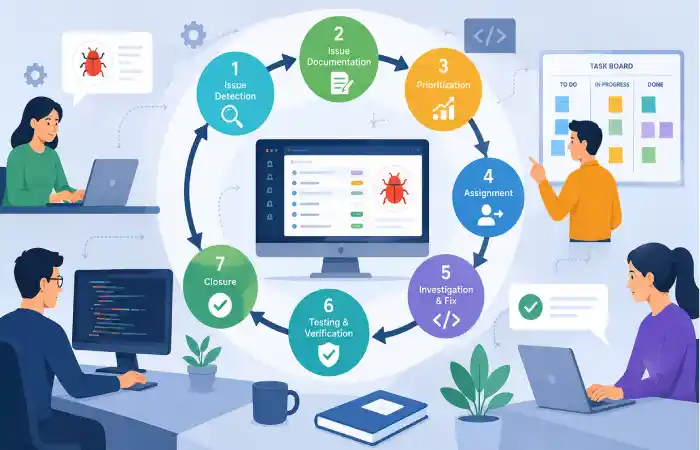
The basic workflow can be understood without getting lost in technical terminology.
1. Issue Detection
Everything starts with identifying a problem.
A defect may be discovered through manual testing, automated testing, monitoring, customer feedback, production logs, or developer observation.
The earlier a problem is recognized, the easier it generally is to understand its cause.
2. Issue Documentation
The problem is recorded with enough information for another person to reproduce it.
Good documentation might include:
- Bug description
- Steps to reproduce
- Expected result
- Actual result
- Device or browser
- Software version
- Severity
- Screenshots or logs
- Related task or release
This creates a shared reference point.
3. Prioritization
Not every bug deserves the same response time.
A spelling mistake on a rarely visited page is different from an authentication failure affecting thousands of customers.
A sensible workflow therefore ranks issues according to factors such as severity, business impact, frequency, security implications, and release requirements.
4. Assignment
Once the issue is understood, it needs an owner.
Assigning responsibility reduces the classic problem of “I thought someone else was handling it.”
Clear ownership also makes project reporting easier.
5. Investigation and Fix
The developer investigates the underlying cause rather than simply hiding the visible symptom.
This distinction is important.
A temporary workaround may make an error disappear, but root-cause analysis tries to understand why the error happened in the first place.
6. Testing and Verification
After the fix is implemented, testers need to confirm that the original problem has disappeared.
They may also perform regression testing to ensure that the fix has not introduced another problem.
7. Closure
Only after verification should an issue be considered complete.
A closed ticket should ideally leave behind a useful history of what happened.
That history becomes valuable later when similar problems appear.
Core Features Associated With Endbugflow Software
Public descriptions of Endbugflow emphasize workflow management, analytics, task organization, collaboration, and structured defect handling.
The most useful capabilities can be understood through their purpose rather than through a long list of technical features.
Centralized Issue Management
A centralized system gives developers, testers, managers, and other stakeholders one place to see active problems.
This is particularly useful when teams work remotely or across multiple departments.
Workflow Automation
Automation can remove repetitive administrative work.
For example, a workflow could automatically notify an assigned developer when a critical defect is created. Another rule could move an issue into a testing queue after a fix is submitted.
The goal is not to remove people from the process. It is to remove unnecessary manual steps.
Status Tracking
A clear status system can show whether an issue is:
- New
- Investigating
- Assigned
- In development
- Ready for testing
- Verified
- Closed
- Reopened
This small amount of structure can dramatically improve visibility.
Analytics and Reporting
Bug data contains more information than many teams realize.
If one module repeatedly generates defects, that may indicate a deeper architectural problem.
If average resolution time is increasing, the team may have an ownership or workload issue.
If bugs are repeatedly reopened, testing or requirements may need improvement.
Endbugflow-related material highlights metrics such as defect density, resolution time, and recurrence rates as useful indicators for quality improvement.
Endbugflow Software vs Traditional Bug Tracking
The difference becomes clearer when the approaches are placed side by side.
| Area | Traditional Bug Tracking | Endbugflow-Style Workflow Management |
| Main purpose | Record defects | Manage the complete defect journey |
| Assignment | Often manual | Structured workflow and ownership |
| Prioritization | Basic labels or manual decisions | More systematic prioritization |
| Collaboration | Can be fragmented | Centralized visibility |
| Automation | Limited depending on tool | Workflow automation is a core idea |
| Analytics | Basic reports | Greater emphasis on process insights |
| Verification | Often separate from reporting | Included in the lifecycle |
| Continuous improvement | Limited | Uses defect patterns to identify recurring problems |
The important point is that a modern workflow is not necessarily better simply because it has more features.
The real advantage comes from reducing confusion.
Endbugflow Software Compared With Spreadsheets
Many small teams begin with spreadsheets.
It makes sense at first. A spreadsheet is inexpensive, familiar, and easy to customize.
But problems appear as the number of issues increases.
| Factor | Spreadsheet | Dedicated Bug-Flow System |
| Small project | Often sufficient | Useful |
| Large project | Difficult to manage | Better suited |
| Automated routing | Limited | Stronger potential |
| History | Manual | Structured |
| Notifications | Limited | Workflow-based |
| Analytics | Requires setup | Usually more integrated |
| Collaboration | Possible but cumbersome | Designed for shared workflows |
A spreadsheet can be perfectly adequate for a small project. The problem begins when the spreadsheet becomes the team’s unofficial project-management system.
At that point, maintaining the tracker may take almost as much effort as fixing the bugs.
The Role of Endbugflow in Agile and DevOps
Modern development teams increasingly work in short cycles.
Agile teams continuously plan, build, test, and improve. DevOps extends that philosophy by bringing development and operations closer together.
This creates an interesting challenge.
The faster software moves toward production, the faster quality issues can also move.
A structured bug workflow helps keep defects connected to development activity instead of treating quality assurance as a separate final-stage activity.
The Endbugflow Software material specifically discusses its relationship with Agile and DevOps-style development, where continuous integration, rapid deployment, and continuous feedback are important.
Why This Connection Matters
Consider a team releasing updates every week.
If bugs are discovered only after deployment, developers may constantly jump between new features and emergency fixes.
A strong workflow helps the team see which problems are blocking a release, which can wait, and which indicate a larger technical issue.
That makes quality part of the development rhythm rather than an afterthought.
Benefits of Endbugflow Software
Better Visibility
Everyone can see what is happening with important issues.
Managers do not have to ask five people for separate updates.
Developers do not have to search through old chat messages to understand an issue.
Faster Resolution
When bugs contain clear information and ownership, developers spend less time asking basic follow-up questions.
That can shorten the path between discovery and resolution.
Fewer Duplicate Efforts
Centralized records make it easier to recognize when two people are investigating the same problem.
Improved Accountability
An assigned owner and visible status create clearer responsibility.
Better Quality Decisions
Historical data can reveal recurring problems.
Instead of simply saying “we have too many bugs,” a team can investigate where those defects originate and how long they remain unresolved.
Stronger Customer Experience
Customers do not care how elegant a team’s internal workflow is.
They care whether the application works.
A disciplined defect process can therefore contribute indirectly to customer satisfaction by reducing recurring failures and improving release reliability.
Who Can Benefit From Endbugflow Software?
A structured bug-flow approach is particularly relevant to:
- Software development companies
- SaaS businesses
- Mobile application teams
- Web development agencies
- QA departments
- DevOps teams
- Product engineering teams
- Startups with growing development operations
- Large organizations managing multiple applications
Small teams can benefit too, although they may not need an elaborate system.
The right level of process depends on project complexity.
A five-person team working on a simple internal application may need only a lightweight issue tracker. A distributed engineering organization managing several production systems may need deeper workflow automation and reporting.
What About Security?
Bug-management systems can contain sensitive information.
A ticket might include source-code references, internal architecture details, customer information, error logs, or security-related findings.
That makes access control important.
The Endbugflow Software site has also published material specifically discussing protection and security considerations around the software.
Organizations evaluating any bug-management platform should consider:
- Authentication
- Role-based permissions
- Data encryption
- Audit trails
- Backup procedures
- Integration security
- Access to sensitive logs
- Data-retention policies
Security should not be treated as an optional extra simply because the software is primarily used for development.
Limitations and Things to Check
One important point deserves attention: public information about Endbugflow is not extensive enough to independently verify every feature, integration, pricing plan, or technical specification sometimes attributed to it online.
Some websites describe Endbugflow as a bug-tracking and workflow solution, while other online pages use the name in broader contexts.
There is also a separate website using the Endbugflow name that presents itself as a technical information and debugging platform rather than a conventional enterprise software product.
Because of that, anyone considering the software should verify the current official product documentation before making a purchasing or deployment decision.
Questions worth asking include:
- What integrations are officially supported?
- Is the product cloud-based, self-hosted, or both?
- What authentication methods are available?
- How is customer data stored?
- What reporting capabilities are included?
- Is API access available?
- What support options are provided?
- What are the current pricing plans?
- How easily can existing issue data be imported?
- Can workflows be customized?
These questions are more useful than choosing a platform simply because it has an attractive dashboard.
How to Get the Most From a Bug-Flow System
Software alone will not fix a poorly designed development process.
A team should first establish a few simple rules.
Define Clear Bug Categories
For example:
- Critical
- High
- Medium
- Low
- Enhancement
- Security
- Regression
The exact categories can vary.
Write Reproducible Bug Reports
A developer should be able to understand the problem without needing a 20-minute meeting.
Keep Ownership Clear
Every active issue should have an identifiable owner.
Avoid Excessive Statuses
Twenty different statuses may sound sophisticated, but they often create confusion.
Simple workflows are usually easier to maintain.
Review Recurring Bugs
A recurring defect is more valuable as a lesson than as another closed ticket.
Ask why the same category of problem keeps returning.
Measure What Matters
Useful metrics may include:
- Average resolution time
- Number of reopened issues
- Critical defects per release
- Defect recurrence
- Open issues by priority
- Defects discovered after release
The objective is not to produce impressive charts.
The objective is to improve software quality.
Is Endbugflow Software Worth Considering?
That depends on what you need.
If you are looking for a simple place to record a handful of bugs, a lightweight issue tracker may be enough.
If your team has a growing number of developers, testers, releases, integrations, and production issues, a structured bug-flow approach becomes much more valuable.
The strongest argument for this type of software is not that it magically eliminates bugs.
No serious development platform can promise that.
Its value lies in making problems visible, organized, measurable, and actionable.
That distinction matters.
Good software teams do not necessarily have zero bugs. They have reliable systems for discovering, understanding, prioritizing, fixing, and learning from them.
Final Thoughts
Endbugflow software represents a structured way of thinking about software defects: a bug is not merely a ticket; it is an event that moves through an entire lifecycle.
That perspective becomes increasingly important as applications become more complex and development cycles become faster.
From issue discovery and documentation to assignment, resolution, testing, and closure, each stage contributes to the final quality of a product. Analytics can reveal recurring weaknesses, while automation can reduce repetitive administrative work. The result is a development process that is easier to understand and, when implemented well, easier to improve.
Also Read: https://www.technologybeam.com