
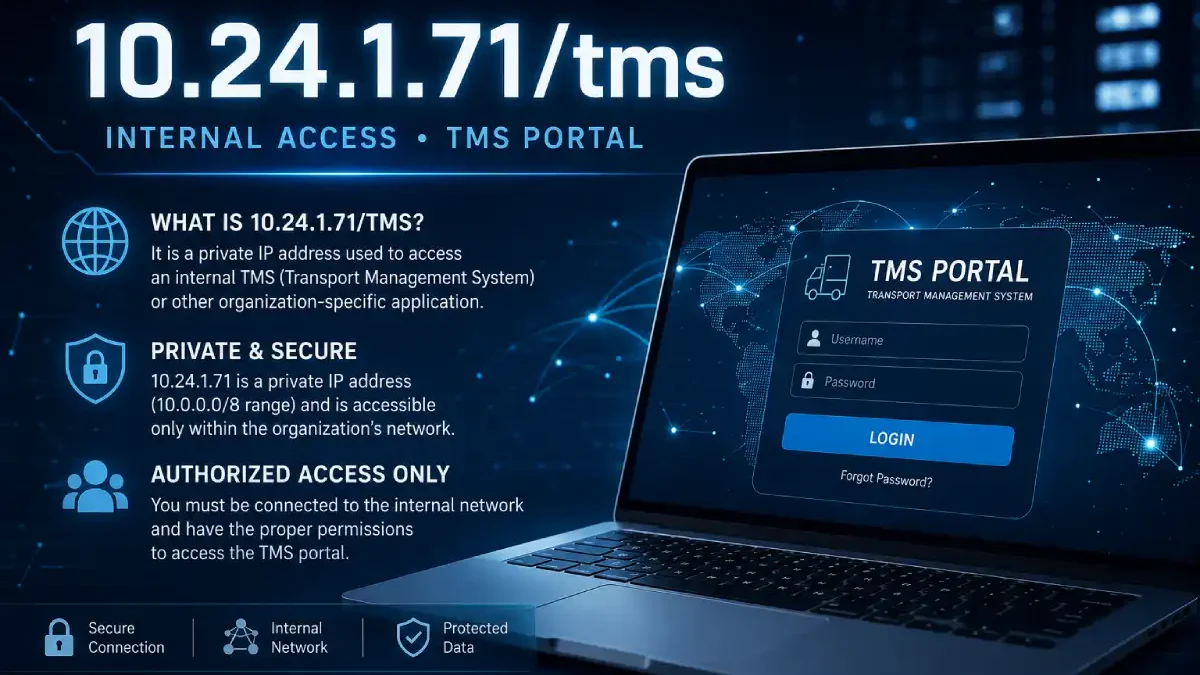

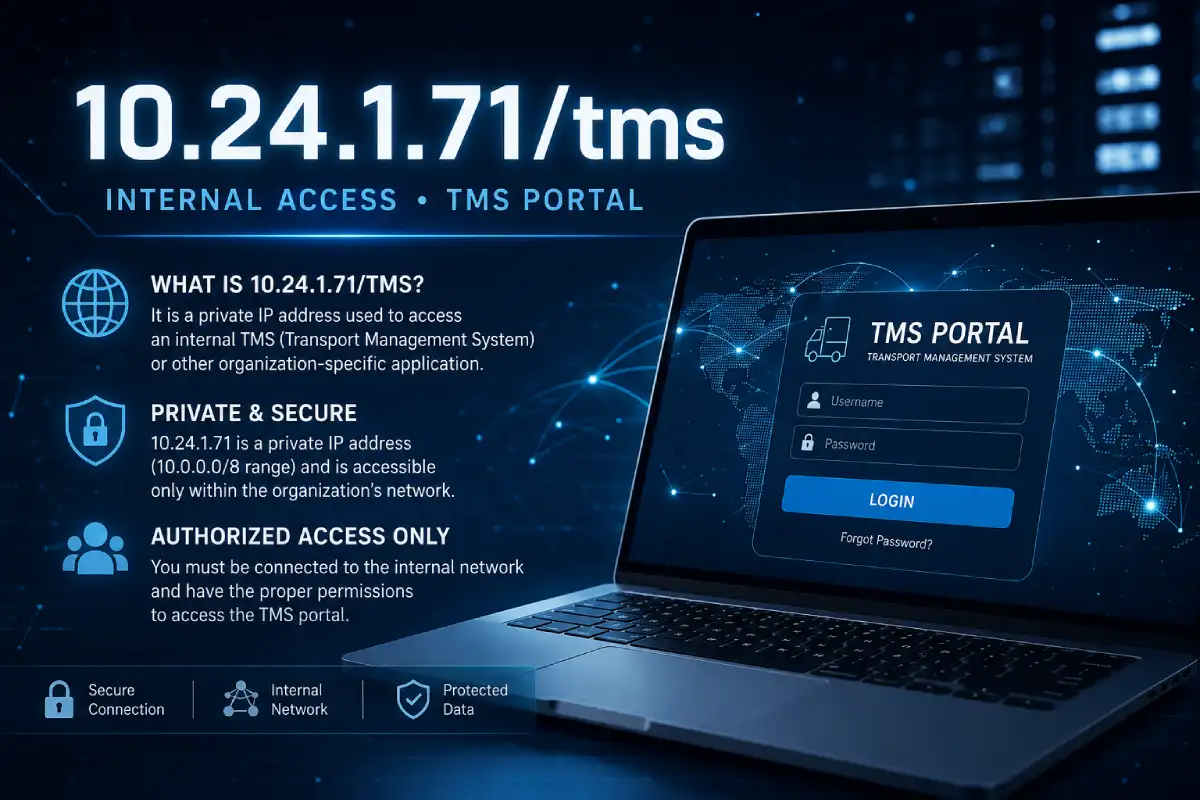
When 10.24.1.71/tms appears in a browser’s address bar, a company document, network configuration, or system, it can seem a bit cryptic. Is it a standard website? Is it a portal for login? What is TMS? And why does the address start with 10.24?
Basically, 10.24.1.71 is an internal or private IPv4 address, and /tms is the file path that directs one to a specific application or service hosted by the internal network. However, what TMS actually stands for will be entirely dependent upon the organization, the installed software, and the specific functionality it holds. There is not a service that all use called TMS to which 10.24.1.71 is routed.
The two concepts must be clearly separated. Thousands of otherwise independent organizations could all be using the same private IP addresses simultaneously because private addresses are not used out on the internet and can be reused by anyone who would like. 10.0.0.0/8 is specified as Private-Use according to IANA, with the same range designated private internets according to RFC 1918.
This next section tells you what’s being shared on 10.24.1.71/tms and will show you what a private IP address is, what TMS might mean, why you are not allowed to access the site, and what to consider before looking at internal sites on the corporate network.
Table of Contents
What Is 10.24.1.71/tms?

10.24.1.71/tms is best understood as a combination of an internal address and application path. First, 10.24.1.71 is a private address space used by one of a multitude of different private networks. In turn, the /tms would refer to path or locations found on web-based or application-based machines.
For instance, here is a breakdown of the address:10.24.1.71 – private network address to an internal host/device/server/file/etc./tms – refers to a path or application on either a local web server or through some application software interface.
Henceforth, one might imagine this being some sort of server, the address, where one is to interact with some application, likely called “tms” via the public web. With that said, however, it cannot be assumed that/tms is any specific kind of software, simply that it’s the designation from the machine to whatever is behind that address.
Some possible interpretations include:
- Traffic Management System
- Task Management System
- Transport Management System
- Terminal Management System
- Technical Management System
- Another organization-specific application
So, the address itself provides useful clues, but it does not reveal the exact software or organization behind it.
What Does the IP Address 10.24.1.71 Mean?
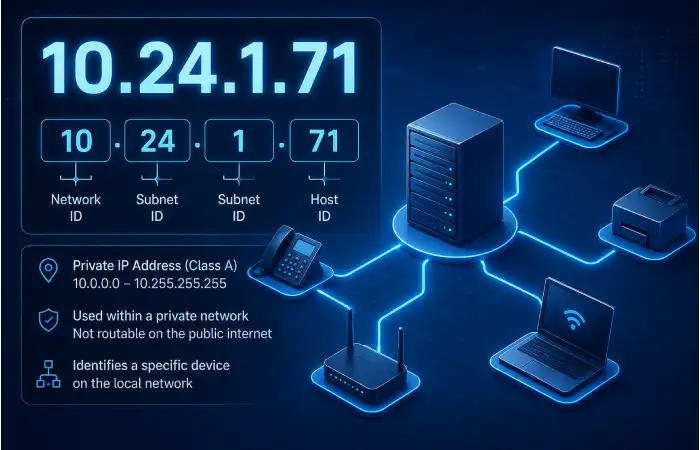
Here, the IP address can be defined as the unique numeric address given to a device on an IP network. The four numbers in the IP address 10.24.1.71
- 24 . 1 . 71
The important detail is the first number: 10.
As a matter of fact, that whole address block (and it covers the space from 10.0.0.0 to 10.255.255.255) has been assigned as private addresses by RFC 1918. As an address, 10.24.1.71, that specific address may be anything except an address with a globally unique routing address that can carry routing information.
Any two unrelated companies could have a computer anywhere in their respective private address space using that very same IP address of 10.24.1.71. The room number 71 only makes sense when you define which building it is referring to; so in 10.24.1.71, the entire rest of the IP range can be assumed to define a building.
What Is a Private IP Address?
A private IP address is an IP address intended for communication within a private network.
Private addresses are commonly used in:
- Offices
- Schools
- Universities
- Hospitals
- Data centers
- Manufacturing facilities
- Corporate networks
- Virtual private networks
- Cloud environments
- Home networks
IANA specifically identifies 10.0.0.0/8, 172.16.0.0/12, and 192.168.0.0/16 as private-use ranges.
Common Private IPv4 Ranges
| Private range | Typical example | Common use |
| 10.0.0.0 – 10.255.255.255 | 10.24.1.71 | Large enterprise networks |
| 172.16.0.0 – 172.31.255.255 | 172.20.5.10 | Business and infrastructure networks |
| 192.168.0.0 – 192.168.255.255 | 192.168.1.20 | Homes and small offices |
The 10.x.x.x range is particularly useful for larger networks because it provides a very large private address space.
Why Can’t Everyone Access 10.24.1.71/tms?
This is probably the most important thing to understand.
A private IP address isn’t intended to function as a normal public website address.
IANA explains that private-use addresses are intended for private networks and should not appear as ordinary destinations on the public internet.
Therefore, if someone types:
10.24.1.71/tms
into a browser from an unrelated external network, several things can happen.
The browser may show:
- “This site can’t be reached”
- “Connection timed out”
- “Unable to connect”
- “Connection refused”
- A blank page
- A security certificate warning
- A login page, if the network happens to have a route to that address
This doesn’t necessarily mean the server is broken.
In many cases, the user’s device simply isn’t connected to the network where that address exists.
What Does /tms Mean?
The /tms portion is called a URL path.
It tells the web server which application, directory, or endpoint the browser should request.
For example:
10.24.1.71/
could refer to the server’s main web interface, while:
10.24.1.71/tms
could point toward a particular application.
The important point is that TMS does not have one universal definition.
One company might use TMS for transport management. Another might use it for task management. A technical department could use the same abbreviation for a completely different internal platform.
That is why the safest explanation is:
/tms is an application path whose exact purpose depends on the internal system configuration.
Is 10.24.1.71/tms a Website?
This can, technically, be accessed via a web browser, and does not, as such, constitute an external website.
It would be more correctly described as a private web app or web interface, assuming there IS an actual web service present on that address.
This distinction matters.
A public website normally has a publicly resolvable domain such as:
example.com
An internal application might instead be accessed through:
10.24.1.71/tms
The second format is particularly common in environments where administrators want applications to remain available only to users connected to a specific network.
What Is a TMS?
A TMS is a software system designed to organize, monitor, control, or manage a particular category of operational activity.
The exact definition varies by organization.
For instance, a Transport Management System might facilitate the scheduling of journeys, whereas a Task Management System could allow for delegating and supervising tasks.
A network-related TMS could potentially be used for monitoring traffic or infrastructure.
This is why it is better to avoid treating the /tms abbreviation as proof of a particular application.
How an Internal TMS Interface Might Work
Although the exact implementation cannot be determined from the IP address alone, an internal web application commonly follows a simple pattern.
1. User connects to the network
The computer first needs connectivity to the organization’s internal network.
That might happen through:
- Office Ethernet
- Corporate Wi-Fi
- VPN
- Secure remote-access infrastructure
2. Browser requests the address
The user enters the internal address into a browser.
3. Network routes the request
The organization’s routers and firewalls determine whether the request can reach 10.24.1.71.
4. Server receives the request
If a web service is running there, it processes /tms.
5. Application responds
It can display an application interface-either a login screen, dashboard, an error message, or something else.
This entire operation takes less than a few seconds when it’s configured appropriately and can be perceived as instantaneous.
10.24.1.71/tms vs a Public Website
| Feature | 10.24.1.71/tms | Public website |
| Address type | Private IP-based address | Usually public IP/domain |
| Typical accessibility | Internal network | Internet |
| Public indexing | Generally not publicly indexable | Often indexable |
| Authentication | Frequently required | Depends on website |
| Network dependency | High | Usually lower |
| Main purpose | Organization-specific | Public-facing service |
| Exact TMS meaning | Depends on organization | Usually identifiable from domain |
The biggest difference is network scope.
A public website is designed to be reachable from the internet. An internal TMS application is generally designed for a controlled group of users.
Why Organizations Use Private IP Addresses
Private addressing is the technology no one talks about until a thing fails. Organizations have come up with a reasonable scheme to have a large private network, but they don’t want the overhead of allocating an individual public IPv4 address to each of those addresses.
RFC 1918 specifically established private address blocks that organizations can use internally without coordinating those addresses with an internet registry.
Some advantages include:
Better internal organization:
Administrators can design their own addressing structure.
Reduced public exposure:
Private addresses aren’t directly reachable as normal public internet destinations.
Address conservation:
Organizations don’t need a public IPv4 address for every internal computer, printer, server, or application.
Network segmentation:
Different departments and services can be placed into separate network segments.
Flexible infrastructure:
The same private address ranges can be used independently by different organizations.
Is 10.24.1.71/tms Safe?
The IP address itself is not the harmful element.
It falls into a valid private range. However, just because it is private does not mean that the applications it houses are safe.
That aspect will vary according to the system itself.
For example, an internal application could still have:
- Weak passwords
- Outdated software
- Poor access controls
- Misconfigured firewalls
- Excessive user privileges
- Vulnerable components
- Insufficient logging
So the correct security principle is simple:
Private does not automatically mean secure.
Your secure private cloud should be configured to handle updates, monitoring, authorization, authentication, segmentation and any other necessary controls.
Why Might 10.24.1.71/tms Not Open?
There are several ordinary explanations.
You Are Outside the Internal Network
This is probably the first thing to check.
If the address belongs to an office or institutional network, an ordinary home internet connection may not have a route to it.
VPN Is Not Connected
Some organizations provide VPN access for remote employees.
If the VPN is disconnected, internal applications may become unreachable.
The Server Is Offline
The device assigned 10.24.1.71 may be switched off, undergoing maintenance, or experiencing a service problem.
The TMS Application Is Not Running
The server itself could be functioning while the web application is unavailable.
Firewall Rules Are Blocking Access
A firewall may allow access only from specific devices, subnets, or user groups.
Incorrect Protocol
The application might expect HTTP or HTTPS specifically. Using the wrong protocol can produce an error.
Port Configuration
The application may not use the standard web ports, depending on how it was configured.
Basic Troubleshooting for Authorized Users
If this is an internal system you’re legitimately supposed to access, start with simple checks.
Check Your Network
Confirm that you’re connected to the correct company, school, hospital, or organizational network.
Check VPN
If remote access is supported, connect to the organization’s official VPN before trying again.
Verify the Address
Make sure you haven’t accidentally entered:
- 10.24.1.17
- 10.24.7.71
- 10.42.1.71
Even a single digit can point to an entirely different device.
Check With the Administrator
If the address is provided by an organization, its IT team can confirm:
- Whether the server is active
- Which protocol to use
- Whether VPN access is required
- Whether your account has permission
- Whether the /tms path is correct
Avoid changing network settings or attempting to bypass access controls simply to make the page load.
Is 10.24.1.71 a Public IP Address?
No.
10.24.1.71 falls inside the 10.0.0.0/8 private-use range.
IANA’s current IPv4 special-purpose registry identifies 10.0.0.0/8 as Private-Use and marks it as not globally reachable.
This is also consistent with RFC 1918, which defines 10.0.0.0 through 10.255.255.255 as private address space.
So you should not expect a public IP lookup service to tell you which company owns 10.24.1.71.
In fact, there may be no single organization associated with that address at all. Different private networks can independently use the same address.
Can You Find the Owner of 10.24.1.71?
Not in the same way you might investigate a public IP.
This is an important distinction.
Because 10.24.1.71 is part of a private-use range, there is no public registry assigning that exact address to a particular company. IANA notes that organizations can use private address blocks without informing IANA, meaning there is no public record showing which organization has assigned a particular private address internally.
The organization that controls the local network can determine what device currently uses the address.
Comparison: Private IP, Public IP, and Domain Name
| Attribute | Private IP | Public IP | Domain name |
| Example | 10.24.1.71 | Publicly assigned IPv4 | example.com |
| Scope | Internal | Internet-facing | Internet-facing or internal |
| Globally unique | No | Yes | Intended to resolve uniquely |
| Publicly routable | No | Yes | Depends on destination |
| Common use | Internal devices | Servers/services | Websites and applications |
| Organization-specific | Yes | Yes | Yes |
A domain name is essentially a human-friendly label, whereas an IP address identifies a network endpoint.
What Information Can We Safely Infer From 10.24.1.71/tms?
There are several things we can say with reasonable confidence:
- 10.24.1.71 is inside the RFC 1918 private address range.
- It is intended for use within a private network.
- /tms is a path requested from a web service.
- The exact TMS application cannot be identified from the address alone.
- Access will normally depend on network routing and authorization.
- The address itself does not identify a particular company.
- A public internet user should not expect the address to behave like a normal public website.
What we cannot reliably conclude is the identity of the organization, exact TMS software, server operating system, or application vendor without additional authorized information.
Common Misunderstandings About 10.24.1.71/tms
“It must be a public website.”
Not necessarily. The private 10.x.x.x address strongly indicates an internal network destination.
“TMS always means Traffic Management System.”
No. TMS is an acronym with multiple meanings.
“If it doesn’t open, the server is broken.”
Not necessarily. Your device may simply lack the required network route.
“Private IP means completely secure.”
No. Private addressing reduces public exposure but does not replace security controls.
“I can identify the company from the IP.”
Usually not. Private IP addresses aren’t globally assigned to individual companies.
Final Thoughts
on 10.24.1.71/tms0.24.1.71/tms is not a conventional public website address. It is more accurately viewed as a private network address combined with an application path.
The 10.24.1.71 portion belongs to the 10.0.0.0/8 private-use IPv4 range established for private networks. The /tms portion likely identifies an internal application, but its exact meaning depends entirely on the organization that configured the server.
If you encountered this address at work, school, or another organization, the most useful next step is to identify which internal network or application supplied it. If you’re an authorized user and the page doesn’t load, check the network connection, VPN, address, and access permissions before assuming something is wrong with the server.